

Last week, we shared a personal note about the challenge of keeping Carbon Removal Updates running and asked readers who find value in our work to consider supporting it financially.
The response genuinely meant a lot to us. Almost 13 readers became paid subscribers, joining the handful of you who have already been supporting the newsletter through paid subscriptions. We’re truly grateful to every one of you who has chosen to back what we do.
We know these are not easy times, with rising costs and inflation affecting almost everyone. The fact that people still chose to contribute to our work, despite that, means even more to us.
And while this has already made a difference, we still need more readers to come on board as paid subscribers if we’re going to keep this service running sustainably.
So, if you’ve been reading Carbon Removal Updates for a while and feel that it saves you time, helps you discover things you might otherwise miss, or simply makes following the CDR field a little easier, we’d really appreciate it if you’re in a position to become a paid subscriber.
We’d also like to do something for those of you who choose to support us in this way. If you’re happy for us to do so, we’d love to feature the people who become paid subscribers each month in the newsletter, sharing a little about who you are, what you do, and the work you’re involved in. It would be a nice way to introduce more of the people behind this community and highlight the many different ways people are contributing to tackling climate change.
Now, let’s get into this week’s Carbon Removal Updates:

JUMP TO SECTION
1. Commercial News
2. Research Papers
3. Web Posts
4. Reports
5. Upcoming Events
6. Job Opportunities
7. Podcasts
8. YouTube Videos
9. Deadlines
10. Featured CDR Companies & Founders
New in Carbon Removal Updates
Starting this week, in a new section at the end of each newsletter, we’ll provide a brief profile of two featured CDR companies and their founders/co-founders, highlighting what the companies do, along with the founders’ backgrounds, roles and contributions to the carbon removal sector.
We’ll begin with companies whose names start with numbers and then progress alphabetically from A to Z.
COMMERCIAL NEWS
Mafix raised $5.4M in pre-seed funding to commercialize silicon fertilizers that accelerate enhanced rock weathering, improve soils and remove CO₂ (ESG Today)
Senken agreed to purchase 50,000 tonnes of permanent carbon removal from Carbonsate’s biomass storage project in Namibia, Europe’s largest such deal to date (Senken)
Remove signed a pre-purchase agreement with India’s Climitra for permanent biochar removals using invasive Prosopis juliflora in Gujarat’s Kutch district (LinkedIn)
CapChar deployed its first commercial unit at Carbon350 near Petersfield, converting local woody biomass into biochar and generating durable removals (LinkedIn)
Eni and SONATRACH expanded cooperation on forestry-based CDR and methane monitoring, measurement and reduction efforts across Algeria (Eni)
Renova, Sysav and Öresundskraft applied for state support in Sweden’s second BECCS reverse auction, seeking shares of up to 1.07 billion dollars in remaining funding (QC Intel)
Captura and ElectraLith formed a strategic partnership to commercialize next-generation lithium extraction technology (Captura)
Romania became the first EU country to compensate aquaculture farms for carbon sequestration, allocating €14.285M for environmental services (Agerpres)
Heidelberg Materials paused its $1.36B Edmonton CCUS project, citing low carbon credit prices and regulatory uncertainty in Canada (Carbon Herald)
Kazakhstan opened 5.2 million hectares of non-forested land for carbon projects to attract investment and expand carbon markets (Astana Times)
Zen Carbon launched Project Maathai in Nairobi, the Global South’s first industrial CO₂ injection deployment at a concrete plant, targeting 15 tonnes of permanent mineralization annually (LinkedIn)
Rainbow issued its 500,000th carbon credit till date after assessing 73 projects across six CDR pathways in Europe, Africa and Asia (LinkedIn)
Sitos Group completed construction of its $9M Treehouse biochar plant in California and began commissioning (Sitos)
Costa Rica reported over 10.2 million tonnes of net CO₂ equivalent removals from REDD+ activities between 2020 and 2023, according to a UN technical review (UNFCCC)
RESEARCH PAPERS
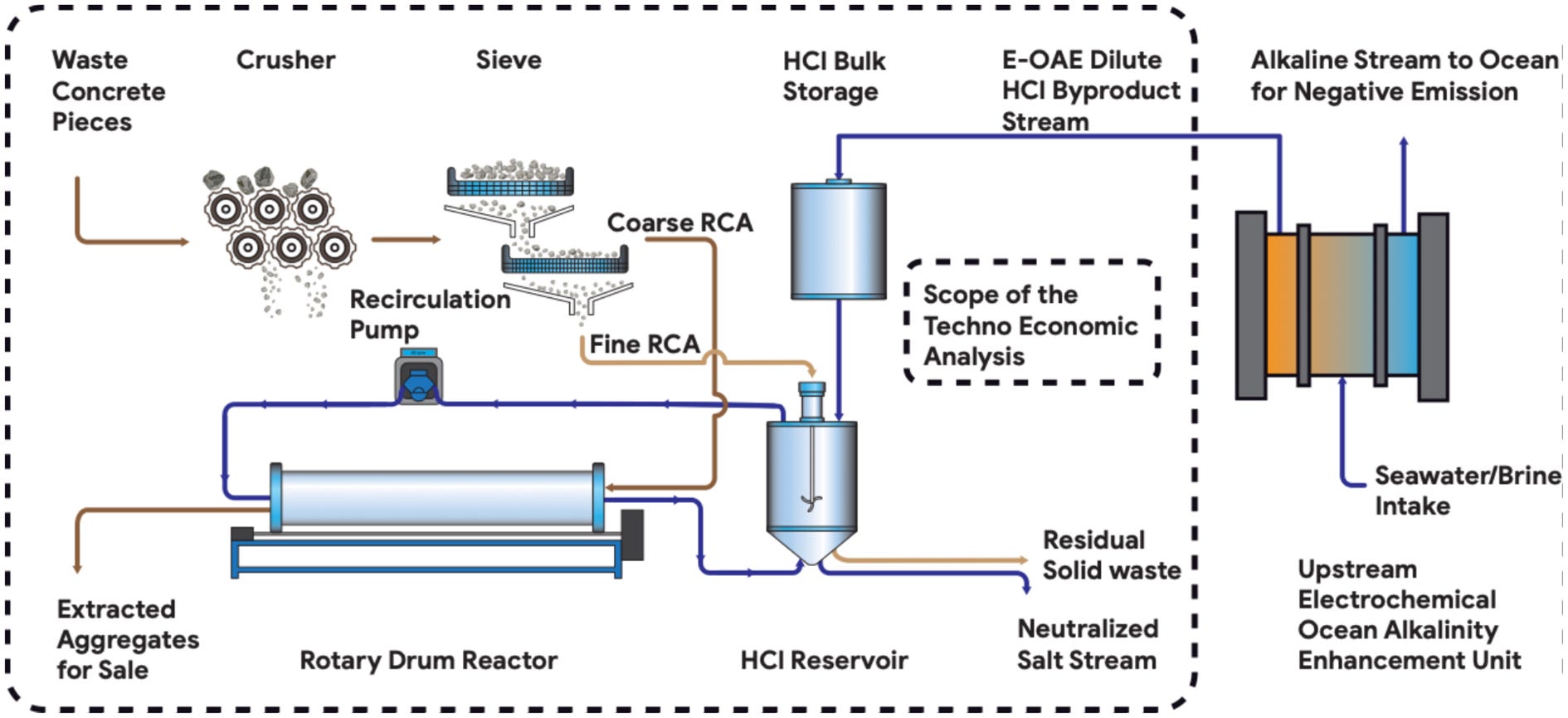
Offsetting carbon removal costs: a techno-economic analysis of waste concrete upcycling using E-OAE byproducts
Authors: Shijian Jin, Anna Lee Tonkovich, Cristian Rodriguez Martinez, Christopher E. Davis, Michael D. Tyka, Ray A. Nagatani, Jr., Christopher Van Arsdale, Antonio R. Papania-Davis
Synopsis: A new approach could turn E-OAE’s acidic byproduct into a revenue stream by using dilute hydrochloric acid to recycle concrete waste. The proposed process treats recycled concrete aggregates in an acid-recirculating reactor, producing higher-quality aggregates while addressing E-OAE acid management. For a facility processing 1,000 tonnes of concrete waste daily, the analysis projects $5.3 million in annual net returns, a five-year payback and $197 in profit per tonne of potential CO₂ removal.
Limits on marine carbon dioxide removal potential set by coastal air-sea gas exchange rates
Authors: Lennart Gerke, David T. Ho, Ulla K. Heede & Tobias Koffman
Synopsis: Measurements in Hvalfjörður, Iceland, reveal that gas transfer velocities can be substantially lower in fjords than in the open ocean at comparable wind speeds, affecting estimates of marine CDR efficiency. Although the fjord’s roughly four-day water residence time allows rapid export to the North Atlantic, where stronger open-ocean gas exchange occurs, this assumption may fail in coastal systems with longer residence times, weaker gas exchange or rapid subduction. Site-specific measurements are therefore essential for accurately estimating CO₂ uptake.
Reforestation dominated China’s forest carbon sink from 1986 to 2019
Authors: Wenru Xu, Zhihua Liu, Philippe Ciais, Wei Li, Yidi Xu, Hong S. He, Jian Yang, Wenjuan Wang, Nianpeng He, Kewei Jiao, Chao Huang, Yangjian Zhang & Jiaojun Zhu
Synopsis: Analysis of China’s forest carbon balance from 1986–2019 finds that reforestation of previously disturbed forests contributed more to the national carbon sink than afforestation, despite afforestation expanding across a larger area. Forest biomass absorbed an average 0.139 ± 0.052 PgC annually, rising to 0.2 PgC/year in the 2010s. Reforested areas also sequestered carbon about 50% faster than afforested land, highlighting the importance of protecting naturally regrowing forests alongside targeted tree planting.
Techno-economics and value judgments of modeling biochar production for carbon removal in climate change mitigation scenarios
Authors: Tabea Dorndorf, Nikolas Hagemann, Anne Merfort, Sabine Fuss, Jessica Strefler
Synopsis: Examining biochar in the REMIND integrated assessment model shows how technology choices and value judgments can shape projected CDR deployment. The analysis classifies biochar production into four configurations and finds that assumptions about geological CO₂ storage are the strongest driver of biochar deployment by limiting competing BECCS. However, optimistic parameterization and inclusion of advanced, currently non-existent technologies also affect outcomes, highlighting the importance of transparent and reflexive IAM practices.
Can we sequester carbon fast enough? growing disconnect between models and reality
Authors: Hugh Daigle and Arvind P Ravikumar
Synopsis: Evidence from two decades of field trials suggests that current subsurface engineering constraints could severely limit the US’s ability to achieve the gigatonne-scale CO₂ storage rates assumed in net-zero pathways. Subsurface properties restrict injection capacity, potentially requiring drilling on a scale exceeding the entire US oil and gas industry to meet modeled targets. The authors call for urgent collaboration on information sharing, technology transfer and supportive policies to overcome these bottlenecks.
Tackling the technological, environmental, legal, and economic challenges of ocean alkalinity enhancement: A case study from the Baltic sea
Authors: Anu Lähteenmäki-Uutela, Jáchym Judl, Jari Silander, Sonja Lavikko, Tuukka Mäkelä, Carolin Regina Löscher et al.
Synopsis: A case study using serpentinite gangue finds that ocean alkalinity enhancement could deliver carbon removal with an estimated emissions footprint below 70 kgCO₂e per tonne of CO₂ removed. However, deployment would require careful assessment of marine ecosystem risks and regulatory permitting. Under the study’s assumptions, OAE would need carbon removal credit prices above €100/tCO₂ to become economically viable, while advance purchase commitments could help reduce market uncertainty.
A review of CO2 removal technologies for a sustainable future
Authors: Amirreza Talaie, Mohamad Ali Fulazzaky, Shahabaldin Rezania & Amin Tamadon
Synopsis: Recent advances in CO₂ control span adsorption, catalytic oxidation, photocatalysis, biofiltration and membrane separation, alongside large-scale approaches such as DAC, CCS and BECCS. The review compares their mechanisms, materials and performance while identifying energy demand, material availability, scalability and cost as key barriers. It also highlights hybrid systems and AI-based optimization as potential routes to improve efficiency, and proposes research and policy priorities for wider deployment.
Variation in the costs and ecological benefits of tropical natural forest regeneration
Authors: Jiaqi Li, Matthew S. Luskin, Robin L. Chazdon & Brooke A. Williams
Synopsis: Mapping restoration opportunities across 7.49 million km² of tropical land reveals substantial potential for natural forest regeneration to deliver both climate and biodiversity benefits. Full regeneration could accumulate about 9.57 GtC over 30 years and reduce extinction risk for forest-dependent species by around 31%. Indonesia, Madagascar, the Philippines, Mexico and Malaysia emerge as major “holistic hotspots,” although areas delivering strong carbon and biodiversity benefits at low cost cover only 9.67% of the assessed region.
Surface Proton Reservoirs Constrain Alkalinity Export from Enhanced Weathering
Authors: Kate Maher; Brian Rogers; Zach Perzan; Tyler Kukla
Synopsis: This study identifies the soil surface proton reservoir (SPR) as a major constraint on enhanced weathering (EW) for carbon dioxide removal. A reactive transport framework shows that alkalinity released from olivine and calcite amendments is largely neutralized in shallow soils, reducing the amount available for export to durable marine storage. Soil pH, moisture, SPR magnitude and amendment rates strongly influence export efficiency, highlighting the need for depth-aware monitoring and improved CDR quantification.
Gradient-based nonlinear model predictive control enabling demand-side management for adsorption-based direct air carbon capture
Authors: Sebastian F. Henzler, Daniel Rezo, Patrik Postweiler, Niklas von der Assen, Alexander Mitsos
Synopsis: Real-time economic nonlinear model predictive control (eNMPC) could make electricity demand management more practical for adsorption-based DACCS. Unlike computationally intensive particle-swarm optimization, the gradient-based approach runs in real time on a standard CPU while enabling finer control of DACCS operations. The analysis finds that eNMPC can achieve more profitable operation, with control resolution, forecasting horizon and optimization tolerance influencing computational performance and paving the way for larger-scale deployment.
An assessment of the suitability of current evidence on European wild seaweed ecosystems for blue carbon accounting
Authors: Ana Julieth Calderón Márquez , Beatrice Smyth , Dan A Smale , Michele Stanley , Pamela Walsh
Synopsis: A systematic review of 16 studies finds that European wild seaweed ecosystems currently lack the evidence needed for inclusion in formal blue carbon accounting. Research provides limited, context-dependent evidence of carbon storage lasting over 100 years, while monitoring methods are difficult to scale and net climate benefits can be reduced by greenhouse gas emissions and variability. The authors recommend a precautionary, conservation-focused approach and further research before seaweed carbon is incorporated into accounting frameworks.
The role of shipping capacity and maritime regulation in ocean liming deployment - Preprint
Authors: Marco Gambarini, Lara Aleluia Reis, Cindy Giselle Azuero Pedraza, et al.
Synopsis: Incorporating ship-based ocean liming into the WITCH integrated assessment model shows that OAE could become a substantial component of future carbon removal portfolios. Under stringent mitigation and constrained shipping availability, ocean liming could reach around 1 GtCO₂/year by mid-century and 1.7–2.9 GtCO₂/year later this century, accounting for 9–15% of total CDR. Deployment is strongly shaped by regulations on permitted sea areas and the availability of low-carbon fuels.
Hybrid membrane–absorption direct air capture of CO2
Authors: Anshika, Raghavendra Ragipani
Synopsis: A hybrid DAC configuration combining membrane separation with absorption could address major drawbacks of standalone systems. Modeling and cost optimization show that the hybrid system could lower costs to about $667/tCO₂, compared with $900/tCO₂ for membrane-DAC, while cutting evaporative water losses by up to 99.4% versus absorber-DAC. Although still above the $100/tCO₂ target, advanced membranes, heat recovery and CO₂ recycling could further improve its economics.
Alkyl carbon in a hydrophobic coating enhances the chemical stability of hydrochar
Authors: Jianping Fan, Fangfang Li, Qingkong Chen, Peiwen Zeng, Yanlin Li, Wei Chen, Qiangbin Yang & Hong Yang
Synopsis: New findings show that hydrophobic coatings formed on hydrochar can influence its stability and carbon sequestration potential in soils. The coating composition varied by plant feedstock, with lotus-leaf hydrochar showing the strongest hydrophobicity. Removing the coating did not change thermal stability but increased carbon loss during chemical oxidation by 10.13–16.01%. The results suggest that alkyl carbon in these coatings helps protect hydrochar from degradation, potentially enhancing its durability as a carbon sink.
A comparison of metrics for CO2 uptake efficiency of regional ocean alkalinity enhancement in an Earth system model - Preprint
Authors: Vanessa Teske, Tronje Kemena, and Andreas Oschlies
Synopsis: This study evaluates methods for measuring CO₂ uptake efficiency from regional OAE using an Earth system model. It finds that global ocean inventories of dissolved inorganic carbon and alkalinity are unreliable for assessing regional OAE because climate variability can obscure the signal. Regional tracking of added alkalinity and air–sea CO₂ fluxes provides more robust estimates, but assessments must account for circulation, natural variability and potential shifts in El Niño timing.
Microbial methane oxidation in aerated subterranean ecosystems: an upscaling and intervention framework for climate change mitigation
Authors: Sean K. Bay, Paul Reginato, Astrid K.M. Stubbusch, Sam Abernethy, Pok Man Leung
Synopsis: Caves and other aerated subterranean ecosystems may represent a previously overlooked sink for atmospheric methane, with aerotrophic bacteria consuming methane transported from the surface. The review develops a framework for estimating this uptake based on ventilation and biological factors and proposes using caves, cave-like environments and potentially decommissioned mines as passive methane biofilters. It highlights major knowledge gaps and calls for research to assess whether subterranean ecosystems could contribute to methane mitigation.
Effects of pH-equilibrated ocean alkalinization on macro-benthic calcifiers: A mesocosm study from the port of La Spezia (Italy)
Authors: Davide Calvi, Sara Groppelli, Federico Comazzi, Samira Jamali Alamooti, Arianna Azzellino, Piero Macchi, Daniela Basso
Synopsis: Experimental results from a mesocosm in La Spezia, Italy, suggest that pH-equilibrated ocean alkalinity enhancement can be compatible with macro-benthic calcifying communities when alkalinity remains below a site-specific saturation threshold. Recruitment, growth and biomass showed no significant negative effects across control to high alkalinization treatments, but an oversaturated treatment caused extensive calcium carbonate precipitation and sharply reduced recruitment and growth. The findings highlight the need for site-specific limits to balance CDR and ecological protection.
Accounting for non-equivalence of carbon emissions and removals in meeting national net zero emissions targets in the United Kingdom - Preprint
Authors: Oliver Broad, Verena Hofbauer, Isabela Butnar, Ingrid Sundvor, and Stephanie Loo
Synopsis: Applying the concept of geological net zero (GNZ) to the UK shows how balancing fossil CO₂ emissions with geological-scale storage could reshape national energy and mitigation pathways. The analysis finds GNZ could potentially be achieved as early as 2040, reducing cumulative emissions by 0.9–2.34 GtCO₂e between 2030 and 2050 compared with current carbon budgets. However, these pathways remain vulnerable to slower emissions cuts, technology disruptions and CDR supply-chain constraints.
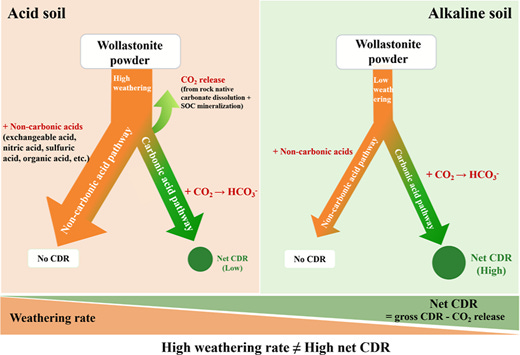
Overlooked Soil Acidity Leads to Significant Overestimation of Carbon Sequestration in Enhanced Rock Weathering
Authors: Chenxia Su; Ronghua Kang; Charles T. Driscoll; Weixing Zhu; Daniel S. Goll; Wentao Huang; Ang Wang; Yunting Fang
Synopsis: Column experiments across different soil pH levels show that enhanced rock weathering with wollastonite can substantially overestimate carbon removal when cation release is used as a proxy for CO₂ sequestration. Although 63%, 48% and 30% of wollastonite dissolved at pH 4, 6 and 8, respectively, cation-based CDR estimates exceeded measured inorganic carbon formation by 1.5–3.1 times. Net CDR was only 0.06–0.46 g C/kg soil, highlighting soil pH as a critical factor in accurate ERW accounting.
WEB POSTS
Lobsters and acidic seas: can shellfish help neutralise one of the greatest threats to the ocean? (The Guardian)
Microsoft’s Global CDR Strategy Targets Scale and Integrity (Sustainability Magazine)
How Spiritus Is Removing the Trade-Off Between Fast Power and Carbon Goals for the AI Era (Data Center World)
Drax bioenergy plant granted permit to use carbon capture to reduce emissions (New Civil Engineer)
Natural leaf coatings may help hydrochar lock away carbon more effectively (EurekAlert)
A bright spot for forestry (Carbon Intuition)
What it Really Takes to Prove a Tonne (Charm Industrial)
The 25-Year-Old Shaping Africa’s Place in Carbon Removal (SLA)
Carbon Capture Goes Electric Microwaves and resistive heating make direct air capture systems more efficient (IEEE Spectrum)
Cities need robust carbon dioxide removal strategies to meet net-zero targets (Nature Climate Change)
Canada’s clean fuel credit market and carbon dioxide removal: The case for legislative reform (MLT AIKINS)
Interview: Patch CEO says CDR marketplaces must prioritise buyer needs (Carbon Pulse)
Post-2030 Deployment Prospects for BECCS and BECCU in Finland (Aalto University)
“This is not science fiction. It is established chemistry and proven logistics.” (Stockholm Exergi)
Inside the world’s largest biogas carbon capture facility (NIB)
Seaweed, and Why It Should Be Voted President (SUS It Out)
GHG Protocol Update: Land Sector and Removals Guidance Now Available (Anthesis)
REPORTS
A benchmark for robust due diligence: BeZero publishes lessons from projects in Microsoft’s carbon portfolio (BeZero Carbon)
Ready Set Remove - Planning your company’s path to carbon removal (The Pembina Institute)
UPCOMING EVENTS
August 2026
From Ambition to Bankability - What Really Unlocks Carbon Projects Investment? | 26 August 2026 | Online
USBC Navigating Carbon Markets: Policy, dMRV, and Scaling Biochar CDR by US Biochar Coalition (USBC) | 26 August 2026 | Online
AOF event with Symbiosis - open to all developers by The Art of Forests Events | 27 August 2026 | Online
September 2026
(NEW) How Mombak delivered the first Symbiosis certificates, two years early by Isometric | 01 September 2026 | Online
(NEW) Building Climate Startups in Emerging Markets by 4Ward | 02 September 2026 | Online
Nordic Climate Finance Summit | 3-4 September 2026 | Oslo, Norway
(NEW) What if removing carbon frem the atmosphere bevomes one of the world’s next major industries by ESG Business Institute | 04 September 2026
Carbon Investor Match Day 2026 by Carbon Capital Lab | 15 September 2026 | Online
Canada’s National CCUS Convention | 15-16 September 2026 | Edmonton, Alberta
Carbon Removal Policy Summit by Carbon Gap | 16 September 2026 | Brussels
COMPASS Workshops for mCDR Professionals - Three free virtual workshops designed specifically for the mCDR community
Developing Your Message | 16 September 2026 | Online
Communicating Risk | 07 October 2026 | Online
Engaging with the Media | 28 October 2026 | Online
Carbon Removal Community Reception: Climate Week NYC Edition! by Carbon Business Council, Carbon to Sea | 21 September 2026 | New York, United States
(NEW) Carbon Removal: Progress, politics, and the path forward by Carbon Removal Alliance | 21 September 2026 | New York
The Potential Role of the Biodiversity Beyond National Jurisdiction Treaty by Institute for Responsible Carbon Removal | 22 September 2026 | New York, US
(NEW) The Wildfire Chain: Carbon Removal to Accelerate Mitigation and Restoration by Mast Reforestation Events | 22 September 2026 | New York
Building a 2030 Carbon Portfolio That Delivers by Gevo | 22 September 2026 | United States
Climate Innovation Challenge: Project Finance with DeepSky and PwC by Centre for Climate and Business Solutions | 26 September 2026 | Vancouver, Canada
Carbon Unbound Europe 2026 | 20-21 October 2026 | London, United Kingdom
Mangroves as next-generation Nature-based Solutions: From digital MRV to carbon markets by Landscape Alliance | 15 November 2026 | Blue Zone, Korea Pavilion
2026 North American Biochar Conference - Setting the Standard for Biochar by American Biochar Institute | November 16-18, 2026 | New Orleans, Louisiana
Massachusetts Carbon Dioxide Removal Study Workshop for the Executive Branch by RMI | 17 November 2026 | Online
Sourcing Minerals for Carbon Removal Roundtable by University of Queensland | 20 November 2026 | Australia
AGU26 Annual Meeting | 7–11 December 2026 | San Francisco, CA | Abstract Submission Deadline: 05 August 2026
Ocean Visions 2027 Summit | 02-04 March 2027 | Hilton Cartagena
2027 Annual Convening by Carbon to Sea Initiative | 18-20 May 2027 | Seattle, WA
We have curated a “Carbon Removal Events Calendar.” Explore and stay informed about upcoming events, conferences, and webinars on Carbon Dioxide Removal technology. Sync specific events / all events to your default calendar to ensure you never miss out on important CDR updates.
Add our Carbon Removal Events Calendar to your default calendar in 2 ways:
Head to this link: https://teamup.com/kshqbfhrqkw36sxymd
Sync specific event: Click the event → menu (≡) → Share → choose your calendar → Save.
Or sync all events: Menu (≡) → Preferences → iCalendar Feeds → Copy URL → Add to your calendar settings → Subscribe.

JOB OPPORTUNITIES
Lead / Director, Marine Solutions at Carbon Removal Canada | Ottawa, ON
“Carbon Removal Canada is an independent non-profit accelerating the responsible scale-up of carbon removal technologies by advocating for impactful, research-backed policies, shaping Canada’s carbon removal market, and connecting the right people to the right information.”
Business Development and Operations Intern at Brineworks | Amsterdam, North Holland, Netherlands
“Brineworks is building the electrolyzer of the future — a patented system that powers ultra-low-cost Direct Air Capture using intermittent renewables and low-cost abundant materials.”
Director of Project Development at Graphyte, United States
“Graphyte is a climate tech company on a mission to deliver the world’s lowest-cost, highest-durability carbon removal.”
Board Director at Carbon Removal Canada | Remote, Canada
“Carbon Removal Canada is an independent non-profit accelerating the responsible scale-up of carbon removal technologies by advocating for impactful, research-backed policies, shaping Canada’s carbon removal market, and connecting the right people to the right information.”
Biochar Market Development Manager at Charm Industrial, Fort Lupton, CO
“Charm Industrial’s mission is to return the atmosphere to 280 ppm CO₂. We convert excess inedible biomass into carbon-rich bio-oil and inject it into underground storage for permanent carbon removal. At scale, we can use bio-oil to make fossil-free iron.”
Project Controller at Skytree | Katowice, Śląskie, Poland
“Skytree enables a transition to a world with cleaner Air for everyone. We do this by developing and deploying smart technology that captures atmospheric carbon dioxide, enabling its use or storage to combat climate change and aid society and businesses around the world.”
Head of Design at Isometric | London
“Isometric is the AI-native certifier of climate solutions.”
Data Scientist at Terradot | São Paulo, Brazil
“Terradot’s mission is to stabilize Earth’s climate by transforming nature’s most powerful permanent carbon removal process into a global climate solution. By advancing science, building technology, and assembling a global coalition, we are catalyzing an initiative to scale Enhanced Rock Weathering within the next decade, starting in Brazil.
Senior International Business Developer – North America & Europe at Removall | Paris
“Removall supports companies and organizations in their climate ambitions by developing and structuring pooled or customized carbon funds, or by implementing rigorous and ambitious carbon offsetting programs.”
Project Lead at Planteers | Hamburg
“Planeteers is a climate-tech startup from Hamburg, Germany. They capture CO₂ in water and unleash the potential of the oceans as the largest carbon sink on our planet.”
Chief of Staff at SuperBiochar | New York
“SuperBiochar is reviving an ancient climate solution—biochar—used for centuries to restore depleted soils.”
Full-Stack Data Scientist at Crew Carbon | Brooklyn, NY; New Haven, CT; Remote
“CREW’s technology and services make wastewater treatment cheaper and more efficient, while permanently sequestering CO₂.”
Manufacturing & Supply Chain Manager at Captura | Pasadena, CA
“By studying the planet’s natural cycles, Captura designed a solution that removes CO2 from the ocean and harnesses its ability to heal the climate—a process known as Direct Ocean Capture.”
Director of Finance and Operations at Ocean Visions | United States, Remote
“Ocean Visions is a nonprofit conservation organization pursuing bold solutions to counter and reverse climate impacts on ocean health.”
Marketing Manager at Black Bull Biochar | Manchester (Hybrid)
“Black Bull Biochar (BBB) is a growing UK company scaling the use of biochar, a carbon-rich material that improves soil health and removes carbon from the atmosphere.”
Agroforestry Technician (Temporary Position through Dec 15th 2026) at Terraformation | Hawai’i County, HI
“Terraformation is committed to addressing climate change through the power of native forest restoration and sustainable farming practices.”
PODCASTS
Influence of Surface Roughness on ERW - Kukla | Reviewer 2 does geoengineering
“How much carbon can enhanced rock weathering actually remove? In this episode, @geoengineering1 talks with Tyler Kukla of CarbonPlan about how assumptions about rock surface roughness can dramatically change enhanced weathering estimates.
They discuss why surface area is critical to weathering rates, how commonly used roughness calculations can overestimate available surface area, and what this means for modeled CO₂ removal. The conversation also explores the differences between surface-area- and water-transport-limited weathering, the challenges of scaling enhanced weathering, and why better measurements are needed to constrain models.
The discussion is based on Tyler Kukla et al.’s CarbonPlan article, How Surface Roughness Scaling Can Mislead Enhanced Weathering Predictions. https://carbonplan.org/research/modeling-bytes-02-roughness”
How a Durham Founder Is Making Carbon Removal Cheaper, Simpler, and Ready to Scale | JD Supra
“Direct air capture technology has the potential to meaningfully reduce atmospheric CO2, but high costs and energy demands have kept it from scaling. In this episode, Cory Sanderson, founder and CEO of Sustaera, explains how his Durham-based climate tech company is taking a fundamentally different approach. Sustaera’s conductive structured sorbent technology uses resistive electrical heating instead of thermal regeneration, making it three to four times more energy-efficient than competing direct air capture systems and far simpler to deploy at scale. Cory also gets into the realities of building a climate tech hardware company in the current funding environment, why patient capital and mission-aligned investors matter more than traditional VC timelines, and how the Research Triangle ecosystem has been a genuine asset on the fundraising trail. Attorney Josh Hayes of Hutchison PLLC joins the conversation to add perspective on the unique legal and structural challenges facing clean tech founders. Hosted by Trevor Schmidt.”
Phosphorus cycling in sediments - Caroline Slomp | Marine Biogeochemistry Podcast
“The number of scientists studying marine phosphorus cycling may align to the Redfield ratio. For every 106 scientists studying carbon, there is one studying phosphorus. This is at least the approximation made by Prof. Caroline Slomp, one of our world’s experts on the marine P cycle. In this episode, I ask questions how P cycles through marine sediments. The challenge is that understanding the P cycle also requires understanding of how iron, sulfur and other elements interact. It is a complex topic, yet getting an idea of what is going on within seafloor sediments feels very rewarding.”
The Carbon Removal Market Won’t Fix Itself | Dr. Andre Sobolewski | The SkyCarbon Enterprise Hour
“A conversation with Dr. André Sobolewski, CEO of Elektra Minerals and former founder of Blue Skies Minerals.
The carbon removal sector has a storytelling problem. Not a technology problem. Not a capital problem. The problem is that the sector has developed a habit of presenting its ambitions as its achievements, its projections as its outputs, and its potential as its present reality. The result is a credibility gap the market itself created — and that the market itself must close.
In this episode, Collins Victory Odabi sits down with Dr. André Sobolewski — a man who spent three decades inside the industrial process of cleaning up what industry leaves behind, and three and a half years discovering what the carbon removal market is not yet equipped to support. He built Blue Skies Minerals, watched it enter insolvency in March 2026, and founded Elektra Minerals one month later. He did not leave the field.”
Inside the Integrity Crisis: What Nature-Based Carbon Markets Still Need — Toby Janson-Smith | This Week in Carbon
“In this episode of This Week in Carbon, hosts Edward Smith and Rene Velasquez sit down with Toby Janson-Smith, CEO and Co-founder of Credegra, and former Chief Innovation and Program Development Officer at Verra, someone who has spent twenty-five years quite literally building the infrastructure that makes nature-based carbon markets possible.”
What Does CDR Actually Cost in Europe? - with Hansjörg Lerchenmüller and Eadbhard Pernot | The CDR Policy Scoop
“In this episode of The CDR Policy Scoop, Eve Tamme and Sebastian Manhart dig into the cost assumptions behind the European Commission’s EU Emissions Trading System review proposal, a month after the impact assessment first set out what BioCCS, DACCS, and biochar carbon removal are actually expected to cost between now and 2040. Sebastian has spent the past weeks tracing where those numbers come from, and brings in Hansjorg Lerchenmuller, Chairman of Biochar Europe, and Eadbhard Pernot, Executive Director of Carbon Management Europe, to stress test the modelling against real project economics.
The picture that emerges is one of a forecast built on remarkably thin foundations. All the Commission’s numbers trace back to just four sources, and because the medium scenario is simply an average of a low and a high estimate, a single shaky assumption can drag the whole range off course. For BioCCS, that means a low cost calibrated against an unverifiable 2022 conference remark and a transport and storage figure of just 38 euros a ton that barely holds up against real infrastructure costs. DACCS fares little better, with the entire range resting on a single McKinsey report whose underlying assumptions were never published.
Biochar gets the most detailed correction. Hansjorg lays out where the European industry actually stands, more than 235 plants and a real scalable price closer to 175 to 200 euros a ton, well above what the Commission’s own modelling implies.
The conversation closes on a shared plea: better data, more transparency about assumptions, and more developers willing to submit real transaction numbers before the next round of forecasts gets built.”
Article 6 Letters of Authorisation Explained - with Lisa DeMarco | The CDR Policy Scoop
“In this episode of The CDR Policy Scoop, Eve Tamme and Sebastian Manhart sit down with Lisa DeMarco to unpack the legal machinery behind Article 6 of the Paris Agreement. A letter of authorization is an enforceable contract by which a host government permits a project to export a piece of its own climate progress. Lisa explains that it only counts as genuine under Article 6 if it conforms exactly to the minimum requirements set out in Article 6.2 or 6.4. She warns that letters of approval, acknowledgement, or no objection are routinely confused in the market, and points listeners to the model LOA forms she helped develop with the World Bank.
The conversation turns to the KOKO cookstove project in Kenya, where two government entities each argued they lacked the authority to issue the LOA, leaving no party accountable when the project collapsed. Lisa breaks down the three part diligence host governments should complete before signing an LOA: confirming which branch of the state actually holds authority, checking the export will not take the country off track from its NDC, and reviewing domestic constitutional questions around trading natural resources.
Lisa and the hosts also dig into revocation, distinguishing between a government’s right to revoke a bad actor’s authorization and the far more consequential question of retroactively cancelling units that have already changed hands, something she compares to printing a dollar bill and tearing it up. On corresponding adjustments, she lays out exactly when they are legally required by law and when not. However, even when projects don’t require corresponding adjustment, arranging a letter of acknowledgement from the government is crucial.
They close by sizing up the market: roughly thirty five Article 6 projects have been authorized since the start of 2025, worth about one hundred million credits combined, against a European Union that alone could need hundreds of millions of credits by 2040.”
YOUTUBE VIDEOS
Net Zero Isn’t Enough: We Need to Remove 1.7 Trillion Tons of CO₂ | Clean Power Hour
“Enhanced rock weathering pulls carbon dioxide from the air using crushed rock. Jim Mann, CEO and founder of Undo, explains how the process works and why the technology scales fast. Undo turns rock dust into permanent carbon storage and sells credits to Microsoft and British Airways at $350 a ton, a price Mann expects to halve within years.
The atmosphere holds 1.7 trillion tons of legacy CO2, and enhanced rock weathering ranks among the few carbon removal pathways built to pull carbon out for good. Jim Mann, CEO and founder of Undo, joins host Tim Montague to break down how his company spreads crushed basalt on farmland to speed up natural rock weathering by 50,000 to 100,000 times, turning atmospheric CO2 into bicarbonate that stays locked in the ocean for around 100,000 years.
Undo counts Microsoft, Barclays, British Airways, and McLaren Racing among its customers, selling durable carbon removal credits at roughly $350 a ton today, with a path toward half that price as the company scales. Mann and Montague debate whether net zero targets go far enough, why the EU’s carbon border adjustment mechanism forms the backbone of a real carbon market, and what enhanced rock weathering needs to move from thousands of tons a year to the gigaton scale the IPCC says the world needs.”
WGES 2025 - Voluntary Carbon Markets A Path to Net Zero or a Double Edged Sword. | World Green Economy Summit
Finca Alía: Our Biggest Carbon Removal Project in Spain - 3 Years Later | Life Terra
“Finca Alía was once a degraded eucalyptus monoculture, cut several times and no longer productive. The landowner decided to remove them and asked us to help restore the land with native biodiversity.
Over 60,000 trees of 19 different native species were planted across 38 hectares. During our latest monitoring visit with ASES, we saw strong growth, high survival rates, and clear signs of insect activity a good indication that the ecosystem is starting to recover.
This is our largest carbon removal project in Spain, and it also aims to restore habitat for the Iberian lynx, one of Europe’s most endangered species.”
Biochar: The “black gold” Germany is betting on for carbon neutrality | Carbon Hunters | Energy Observer
“In Hamburg, Germany, one word keeps coming up: Pflanzenkohle, biochar. Named by the IPCC in 2018 as a credible climate solution, this carbon-rich charcoal can lock away CO2 for centuries. Germany is betting big on it to hit its carbon neutrality targets.
From backyard workshops with “climate hacker” Elena, to Novocarbo, a startup running the country’s largest carbon-capture site, to biochar-enriched asphalt roads storing carbon under our tires, Carbon Hunters investigates how far this “black gold” can really go.
Biochar could capture up to 2.6 billion tonnes of CO2 out of the 40 billion tonnes emitted globally each year. It won’t solve the climate crisis alone, but combined with other solutions, it might just move the needle.
Energy Observer is the world’s first experimental vessel to be fully autonomous in energy. On board, the Carbon Hunters series investigates the technologies and innovations driving the fight against climate change.”
The “McDonald’s of Biochar”: Why We Built Terraton | Terraton
“In this video:
Why biochar has to be profitable to work as a climate solution
Inside Terraton’s first site, a partnership with nut processor EcoFix in Kenya
How Terraton aggregates data and improves operations across facilities using software
Terraton’s near-term goal: 100 facilities removing a million tonnes of CO2 a year”
Building Sustaera: Making Direct Air Capture Simpler and More Efficient | Founder Shares | Hutchison PLLC
“In this episode of Founder Shares, host Trevor Schmidt talks with Cory Sanderson, founder and CEO of Durham-based climate technology company Sustaera, and Hutchison attorney Josh Hayes.
Cory explains how Sustaera’s direct air capture technology works and why the company has focused on making carbon removal simpler, more energy-efficient and easier to deploy at scale. He walks through the company’s conductive structured sorbent technology, its electrical regeneration approach and the path from a tabletop demonstration unit toward larger-scale field validation.
The conversation also explores the business behind the technology: the challenges of raising capital for clean tech hardware, why patient and mission-aligned investors can be particularly important, and how relationships throughout the Research Triangle ecosystem have helped open doors.
Josh shares his perspective from working with Sustaera since its early days and discusses some of the corporate, intellectual property and structural fundamentals founders should address as their companies develop.”
Mining the Atmosphere: The Future of Direct Air Capture of CO2 | Dr. Gerhard Schöny, DACworx | S2E12 | The Energy Bridge
“In this episode, we cover:
From Research to Industrial Reality: Dr. Schöny shares his journey from nearly a decade of research at TU Wien into the industrial world of Wien Energie and Dieffenbacher—and how managing real energy assets changed his understanding of what innovation actually means.
The DACworx Technology: How DACworx is tackling the efficiency challenge in Direct Air Capture through a split architecture separating adsorption and desorption—and why this could reduce energy consumption compared with current benchmarks.
Waste Heat & Energy Integration: Why low-grade industrial waste heat below 100°C could become a critical energy source for DAC, potentially covering a large share of the process energy demand—and what makes a site truly “DAC-ready.”
DAC as Infrastructure, Not a Gadget: What happens when carbon removal is designed as an integrated part of an industrial energy system? We explore the role of system integration, sorbent lifetime, operating costs, and the path toward large-scale deployment.”
Global Visionaries special: Dan Grotsky, co-founder of Groundwork BioAg | Monocle Radio
“Monocle Radio is a round-the-clock global audio service featuring live shows and podcasts that cover news, entrepreneurship, culture, design, urbanism, media and more. Tune in to hear our editors, correspondents, sector specialists and canny contributors across the schedule, as well as a perfect soundtrack of great music from around the world.”
Weekly Carbon Removal Updates from 17 August - 23 August 2026 | Carbon Removal Updates Bulletin
DEADLINES
Remove, the non-profit CDR accelerator, backed by Milkywire’s Climate Transformation Fund, has officially launched its first Latin American CDR accelerator | Applications close 30 August 2026
Swedish Energy Agency opened 15M SEK funding for negative emissions R&D | Deadline: 31 August 2026
Vietnam’s Net Zero Challenge, the country’s largest climate technology innovation competition, has opened applications for its fourth edition, offering over $800,000 in prizes | Applications close 31 August 2026
Germany launched €5B Carbon Contracts for Difference program to support CCS and CDR | Tender submission deadline: 07 September 2026
ISO has opened its draft ISO 14060 carbon credit procurement rules for consultation until 09 September 2026, proposing durable CDR purchases within five years of setting a net-zero target.
The European remove CDR Accelerator program is accepting applications | Deadline: 13 September 2026
Google launched its 2026 Carbon Removal and Superpollutant Elimination R&D Awards, offering over $6 million in grants, with individual awards up to $450,000 | Deadline: 25 September 2026
Deduci launched a US CDR portfolio with Isometric, featuring improved forest management, subsurface biomass storage and biochar projects | Procurement closes 30 September 2026
Carbon to Sea launched two 2026 funding calls totaling up to $6 million for Ocean Alkalinity Enhancement research | Pre-proposal deadline: 30 September 2026
Carbon Management journal calls for CDR papers | Deadline: 13 November 2026
(NEW) Call for Papers: Challenges and Solutions for Carbon Dioxide Removal: From Governance and Regulation to Monitoring and Sustainability | Manuscript Submission deadline: 13 November 2026
The Ocean Science Equity Initiative announced to offer travel grants for individuals to attend mCDR conferences and meetings | Applications deadline: 15 November 2026
CIEIF announced another round of three grants with award amounts of $75,000 each | Deadline for applications is December 1, 2026
Call for Manuscripts | Research Topic: Forest Carbon Sinks: Fluxes and Storage Capacity | 31 January 2027

FEATURED CDR COMPANIES & FOUNDERS
The companies featured in this series are drawn from Grant Faber’s CDR Companies List and the Carbon Drawdown Initiative’s CDR Company Directory. The information and profiles presented here are based on our independent research.
106 Reforestation is an ecological management company based in Sandy, Utah, focused on restoring high-elevation forests through its “No Burn” approach, which mechanically removes overgrown and aging trees to improve forest health, wildfire resilience, watershed performance and native species regeneration. The company also converts removed woody biomass into biochar, creating a pathway for carbon storage while generating a potential revenue stream from forest restoration.
Founder: Mike Siaperas - Siaperas is a Utah entrepreneur who transitioned from a successful career in medical billing software to environmental conservation. Driven by a passion for the outdoors, he shifted his focus after acquiring a heavily overgrown ranch on the Tavaputs Plateau. After experiencing the threat of wildfire firsthand, he dedicated himself to land management and developed a mechanical clearing method using heavy machinery to restore native ecosystems. He also operates Range Valley Ranch and leads philanthropic initiatives, including therapeutic outdoor retreats for military veterans.
1PointFive is a carbon capture, utilization, and sequestration company based in Houston, Texas. As a subsidiary of Occidental (Oxy), it develops industrial-scale Direct Air Capture systems and geologic sequestration hubs to remove carbon dioxide from the atmosphere for hard-to-decarbonize sectors. Its flagship facility, STRATOS, located in Texas, aims to capture 500,000 metric tons of carbon annually.
Founder: Jeff Green - Green is a prominent clean-tech entrepreneur and managing partner at Rusheen Capital Management, specializing in scaling sustainable technologies. Throughout his career, he has launched or backed over ten companies, serving as a critical bridge between early laboratory innovations and industrial deployment. He famously founded NanoH2O, a pioneering water desalination venture later acquired by LG Chem. Green continues to drive climate infrastructure as the founder of 1PointFive and Avnos, while also serving as executive chairman of Moleaer, focusing heavily on atmospheric carbon removal.
Follow us on:
Twitter | Bluesky | LinkedIn | YouTube | Substack | Podcast 1 | Podcast 2
As usual, a super wealth of info for cdr folks. Choose your flavor! Am general greeing up but definitely lean towards natural fast growth/CO2 uptake biota like algae( all ) and bamboo.
Andrew, I know it's not cdr proper but one thing that all cdr relies on is WATER. Land carbon sinks are generally plant driven and need wster which is disappearing. Maybe include water here or have a water/hydro cycle/supply section.
Even srm when talking clouds ice and just water bodies the common denominator is water as a big albedo factor.
We are a water planet trying to restore Goldilocks mode.
Just a pondering I have because I look at 3 pathways for solutions all the time: reflection ( solar geo covers alot of that), natural/enhanced drawdown ( cdr covers alot of that) but WATER is missing.
My tuppence. Your stuff is a Godsend. Now I'm greedy. Give me more! I want water!
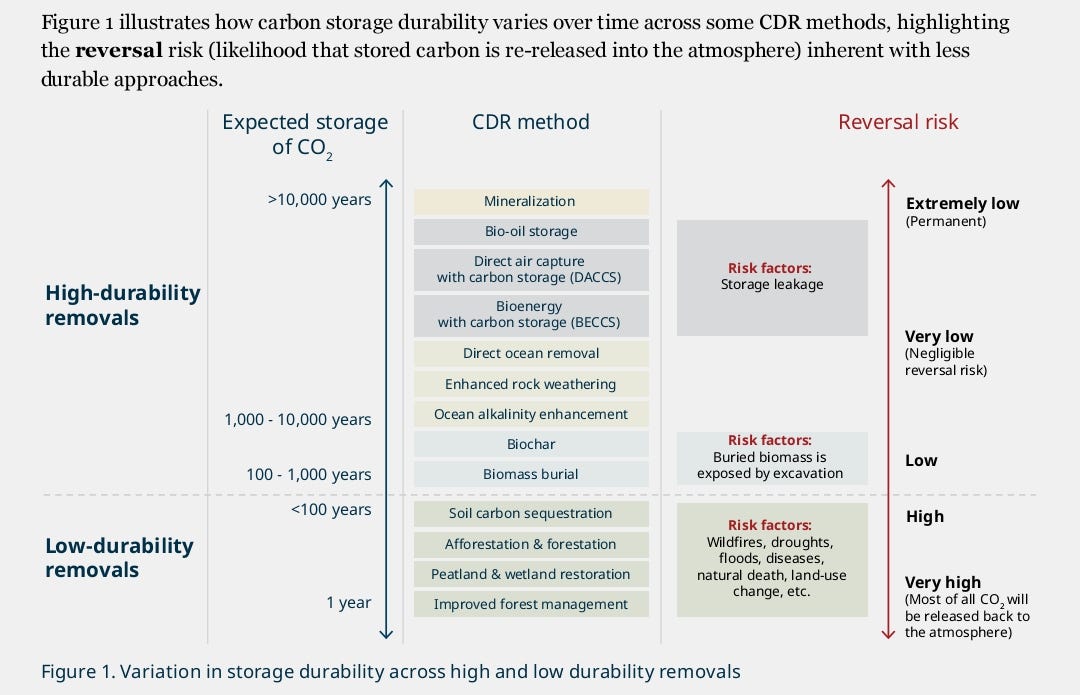
Where would biochar in concrete sit on the durability chart? There would be many opportunities for forestry slash conversion and implementation in concrete.